

We are what we repeatedly do. Excellence, then, is not an act, but a habit. Aristotle
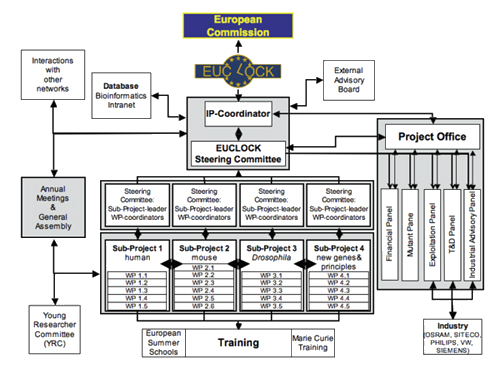
Therefore, EUCLOCK combines the expertise of 34 chronobiologists from 29 institutions in 11 European countries. EUCLOCK's budget is more than 16 million EUR over 5-years, of which 12 millions are a contribution by the European Union.
EUCLOCK researchers utilise the most advanced methods of functional genomics and phenomics in order to compare genetic model organisms and humans. For example, the prerequisites for large-scale, non-invasive research on human entrainment in the field will be developed. The first animal models for shift-work will be created. In analogy to 20% of Shift Workers in the population, flies and mice will be exposed to 'shift work' schedules. They will be active and fed out of phase with their natural rhythms. The ensuing "dys-entrainment" will be investigated at levels from genes to behavior. This work aims at providing insights for the prevention of the negative consequences of human shift-work.
Furthermore, new genetic components that control the circadian clock and its entrainment will be identified in animals and in humans. New tools will be developed and new circadian model organisms will be explored. These will enable the field of chronobiology to exploit the advantages of systems biology research on circadian timing to be performed and integrated at the level of the genome, the proteome, and the metabolome.The innovations of EUCLOCK are predestined to shape the future of circadian research.
EUCLOCK is divided into four Sub-Projects that each manage specific Research activities and implement EUCLOCK's objectives:
- SP 1: Humans (Anna Wirz-Justice, University of Basel)
- SP 2: Mice (Urs Albrecht, University of Fribourg)
- SP 3: Flies (Charlotte Helfrich-Förster, University of Regensburg)
- SP 4: Novel clock genes and principle (Martha Merrow, University of Groningen)
In parallel EUCLIS (EUCLOCK Information System) is established to support the infrastructure between EUCLOCK researchers and the worldwide Chronobiology community. EUCLIS is an advanced database architecture, which will integrate experimental data, computational models and external information. (Eduardo Mendoza, LMU Munich & University of the Philippines Diliman)